


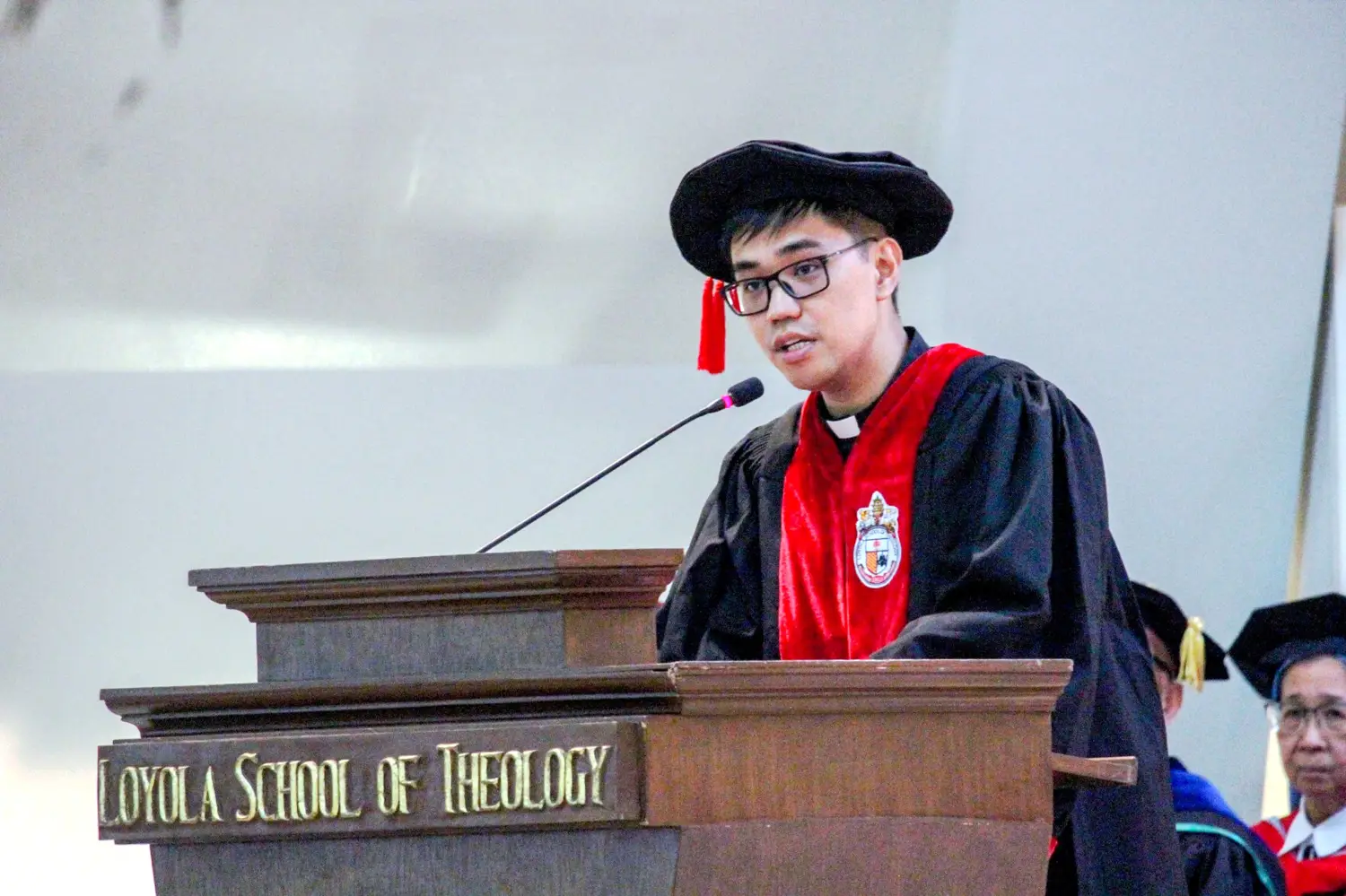
Valedictory Address of Rev. Dom Joseph B. Bulan, SJ at LST’s Commencement Exercises 2026
His Excellency, The Most Reverend Marcelino Antonio Maralit, Jr., Bishop of San Pablo; Fr. Xavier Olin, Vice Chancellor and Provincial of the Society of Jesus in the Philippines; Fr. Renato Repole, President of Loyola School of Theology; Fr. Rogel Abais, Vice President for Academic Affairs; members of the LST Administration; our dear professors, fellow graduates, family and friends, magandang hapon po sa ating lahat.
It was only four years ago, back in 2022, when most of us began our theological studies in a state of crisis – behind screens and masks, as we were still reeling from the tail-end effects of the COVID pandemic. Now, we end it in a world still in crisis. This crisis is visible in war-torn places like Gaza, Lebanon, Ukraine, and Myanmar, places which some of our batchmates consider as home; and invisible yet felt by everyone, especially the poor, in the anxieties brought by the rising costs of fuel. As graduates of LST in its 60th year, what, then, can we offer to this world in crisis? Ano ang maiaambag natin sa ating lipunang nasasadlak sa karahasan, katiwalian, at kahirapan? As men and women of the Church, what can our training contribute to our communities beset with violence, corruption, and poverty?
I believe if there is one thing that we can contribute and offer, it is to share the distinctive kind of theology that LST has. Specifically, LST’s way of forming us is through a theology that disarms. And this same disarming theology is what we hope to share in whatever circumstances we find ourselves in the future. What do I mean by a theology that disarms, or a disarming theology? Allow me to offer three points this afternoon.
First, our theologizing in LST is one that disarms the heart. Across courses, one thing personally stood out for me as a student. Our professors were not content with providing content. Regardless of the subject, they ensured that what we learned would lead us to a deeper and more personal encounter with Jesus Christ. And isn’t this Lord, ὁ λόγος σὰρξ ἐγένετο, the Word-made-flesh whom we discover in our classes, disarming in his own right? He was neither theologian nor scholar, but he had a way of explaining who God was through his stories and his hands. He chased people, called prostitutes and tax collectors, and proclaimed glad tidings to the poor. He left many confused when he called God “Abba”, when he referred to himself as “The Bread of Life”, and when he said that he would destroy the temple, only to build it up after three days. And at the decisive moment when he faced death, didn’t he also choose to embrace the Cross, even when others denied and deserted him? And finally, after the Resurrection, this same Jesus simply appeared to his friends, expecting they would recognize him, as if nothing miraculous happened. Quite disarming, if you would ask me.
In coming to know this Jesus who unapologetically and unconditionally loves us and calls us by name, our defenses are put down and our hearts are softened to appropriate the insights we learned in our classes. A few of my batchmates would casually remark how some days would feel less like lessons and more like recollections. Siguro kasi, sa LST, may talab sa puso ang pagteteolohiya. In LST, our way of theology cuts through the heart. It is my hope that we share this way of theologizing in our future ministries – a kind of theology that does not only nourish the mind, but satisfies the heart, and leads to a more resonant encounter with our God and his beloved people.
Second, our theological training in LST also disarms the mind. Do you remember, from our first days in school, that we were told not simply to memorize propositions and doctrine (important as they may be)? And neither are we to learn by parroting verses from the Scriptures or lines from the Catechism. More importantly, we were not trained to give template answers to questions we encounter from the faithful – from the nanays in our apostolate areas, from the sick patients we give communion to in the hospitals, from the youth we give recollections to in our schools and parishes.
Instead, LST taught us to humbly admit that we do not have the answers to all the questions about the faith. In an age where artificial intelligence could generate responses to almost any inquiry, our formation reminded us that belief cannot be reduced to information, and that true understanding requires presence, attentiveness, and lived encounter. Moreover, it dismantled the false sense of entitlement that can come from being a religious, a seminarian, or a student of theology, by reminding us that theologizing already happens in the unlikeliest of places, and that our role is simply to help people articulate better their already-rich experiences of God.
Following the charism of St. Ignatius of Loyola, we were taught to discern, even when it is messy and inefficient – to listen first, to see the person behind the problem, and to notice where the Lord leads. The kind of theology LST imparts is one that frees the mind from intellectual arrogance. I sincerely hope that the diplomas we will receive this afternoon will not be a license for us to feel superior over those who have no theological training. Instead, may it be a reminder for us to question responsibly and discern faithfully, and to be at the service of those who are not as privileged to study like us.
And finally, our stay in LST reminded us of the rich diversity of peoples and experiences. I believe this goes far beyond the cultural presentations that we witness in our gatherings and conferences. Being a student of LST expanded our perspective about how the faith is concretely lived out in the world. Here, we are blessed to be with fellow students from different countries, each one bringing their unique traditions and religious practices. In our classrooms and lecture halls, we enjoy the company of men and women, of laity, religious, and clergy. During discussions, diverse perspectives are entertained, making the learning atmosphere more enriching
Amidst this diversity, we have learned to build a strong sense of community where all are welcome, seen, and heard. Personally, having classmates and friends from all over the world broke down my own biases and misconceptions about their respective cultures and traditions. Iisa man ang Diyos na ating kinikilala, iba’t iba tayo ng paraan ng pagkilala sa kanya, at dapat itong ipagdiwang. While we profess our faith in the same God, our way of living it out is colored by our contexts, and this is a reason to celebrate, not a cause for panic.
In turn, this spirit of fraternity stands as a disarming communal witness to our world plagued by division, exclusion, and intolerance. I earnestly hope that we bring this synodal stance, one that listens before speaking, walks with others rather than ahead, and builds bridges instead of walls, so that in our wounded world, we may become credible witnesses to a Church that is truly a home for “everyone, everyone, everyone” (as our beloved Pope Francis used to say).
Before I conclude, allow me to take this opportunity to express my gratitude to the many people who have led me to where I am now. To my family, for your unwavering support; especially to Papa and Mama, for bringing me up in the faith, and for your prayers (both here and in heaven) that have sustained me, especially in the moments when I doubted myself and Christ’s call; to my Jesuit batchmates, formators, and brothers in community, for your trust, as well as all the places and people that have nursed my vocation, from candidacy, to novitiate, to philosophy, to regency in Zamboanga, to theology and finally diaconate ministry especially in East Timor. I would also like to thank all my teachers and mentors here in LST, for your guidance and inspiring example, especially to Fr. Arnel, Fr. Manoling, Fr. Genie, Fr. Francis, Fr. Pops, Fr. Rex, Fr. Rogel, Doc Jake, Doc Abbie, Sr. Bernie, and my MA thesis mentor, Fr. Sunil; to all my fellow batchmates, classmates, and friends in LST, for the happy and sometimes traumatic moments we have shared; to Fr. Nono, Les, Kuya Rey, and Pat from the Jesuit Music Ministry, for giving me the creative space to articulate my theology through music; and to everyone who worked hard to make this commencement exercises possible, maraming maraming salamat po.
Allow me to end with a story. As I was preparing to write this speech, I was honestly at a loss with how to begin and what to say. So, I talked to some people who knew us and LST best: our beloved LST staff. I asked them one simple question: If you have one message to the graduates of LST, what would it be? I received a lot of nice answers – from Kuya Glenn, Kuya Jerry, Ate Jane, Ate Malou, and others, but the one that touched me the most was from Kuya Juvel. What he said was quite simple, but I believe it is worth sharing to all of us today.
Kuya Juvel said, “Ipagpatuloy ang paglilingkod sa Diyos at sa mga tao. Maging simple. Maging masaya at magbigay saya. At magbigay ng pag-asa.” (“Continue to serve God and his people. Be simple. Be joyful. Bring joy. And bear hope wherever you go.”) As alumni of LST, may our lives and ministries be marked with a disarming simplicity, joy, and hope. May the theology we have learned take flesh in our lives, disarming hearts, minds, and communities wherever we are sent.
Congratulations to all of us, and may the God of peace who has begun the good work in us bring it to fulfillment! Muli, magandang hapon po sa ating lahat.


