


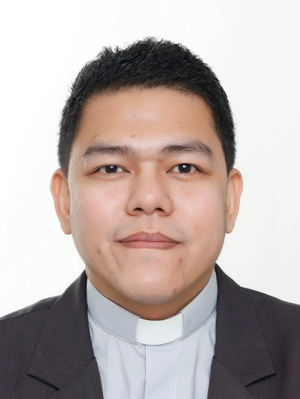
The Theology and Ministry Program of the School of Humanities and the Loyola School of Theology invite you to the oral defense of the Ph.D. Dissertation/S.T.L. Tesina entitled “A CHURCH IN THE SPIRIT: The Reception of Vatican II’s Pneumatological Ecclesiology in Pope Francis’s Vision of a Synodal Church” by Fr. MIKHAIL P. CABANGISAN (Archdiocese of Palo) on 27 October 2026, Tuesday, 2:00-4:00 p.m. at DLC 201 (Tipanan ni San Ignacio), 2/F Dela Costa Bldg., Loyola School of Theology. The Board of Examiners is composed of Fr. Manuel Francisco, S.J., S.T.D. (Adviser), Fr. Jose Mario Francisco, S.J., S.T.L., Ph.D. (Second Reader/Principal Examiner), Fr. Oliver Dy, S.J., S.T.D., Ph.D., Fr. Rowan Rebustillo, S.T.D., Ph.D., and Fr. Ramon Echica, S.T.D. The defense is being held in partial fulfillment of the requirements of the civil degree Doctor of Philosophy in Theology and ecclesiastical degree Licentiate in Sacred Theology, both concentrating in the field of Systematic Theology. It is open to the public.
Abstract: Synodality in the Church is an invitation to reinvigorate a tradition that has always existed, grounded in the desire of God to journey with humanity. This concept emphasizes that the purpose of journeying together is rendered meaningless without God as its foundation. However, the contemporary renewal of synodality in the Catholic Church has generated important theological questions concerning its foundation, purpose, and relation to ecclesial communion. While synodality is often understood as a Spirit-led process of participation, discernment, and mission, this study argues that a deeper foundation lies in the Church’s participation in the priesthood of Christ through the Holy Spirit. The research contributes to a more integrated pneumatological dimension within the theology of priesthood and ecclesiology, without which tensions between the common priesthood of the faithful and the ministerial priesthood persist.
Employing a historical-theological and constructive method, the study first traces the development of pneumatological Christology from the biblical period through the patristic, medieval, and modern traditions. It then examines Marc Ouellet’s theology of pneumatic priesthood, particularly his Trinitarian-pneumatological understanding of Christ’s priesthood and the differentiated participation of the baptized and ordained in the one priesthood of Christ. Building upon Ouellet’s insights, the study develops the concept of pneumatic priesthood as an ontological reality.
The central argument of the dissertation is to rethink synodality through pneumatic priesthood that constitutes the ontological foundation of synodality. While pneumatological synodality describes the Church’s Spirit-led mode of existence, pneumatic priesthood identifies the deeper ecclesial reality that makes such a mode of existence possible. Synodality is therefore understood not merely as a pastoral method or ecclesial process but as the ecclesial form through which the Church’s participation in Christ’s priesthood through the Holy Spirit becomes historically embodied. The gift of Christ’s priesthood, shared by both ordained ministers and the laity, is central to synodality, fostering unity rather than division within the Church.
The study concludes that a renewed pneumatological understanding of priesthood offers a constructive framework for overcoming clericalism, strengthening ecclesial communion, fostering co-responsibility among the baptized, and deepening the Church’s synodal vocation. In this way, pneumatic priesthood contributes to contemporary ecclesiology by providing a theological foundation for understanding synodality as communion, participation, and mission in the life of the Church.


